
Solar power continues to expand rapidly. The United States now has 121.4 gigawatts (GW) of solar photovoltaic (PV) capacity, producing enough solar energy to power more than 23 million homes. Millions of Americans have invested in solar energy and millions more are ready to join them. America’s major cities have played a key role in the clean energy revolution and stand to reap tremendous benefits from solar energy. Our eighth survey of solar energy in America’s biggest cities finds that the amount of solar power installed in just nine U.S. cities exceeds the amount installed in the entire United States 10 years ago.
Solar power continues to expand rapidly. The United States now has 121.4 gigawatts (GW) of solar photovoltaic (PV) capacity, producing enough solar energy to power more than 23 million homes. Millions of Americans have invested in solar energy and millions more are ready to join them.
America’s major cities have played a key role in the clean energy revolution and stand to reap tremendous benefits from solar energy. As population centers, they are major sources of electricity demand and, with millions of solar rooftops, they can be major sources of clean energy production as well.
Our eighth survey of solar energy in America’s biggest cities finds that the amount of solar power installed in just nine U.S. cities exceeds the amount installed in the entire United States 10 years ago. Of the 56 cities surveyed in all eight editions of this report, 15 recorded a tenfold increase in their solar capacity between 2014 and 2022.
To continue America’s progress toward renewable energy, cities, states and the federal government should adopt strong policies to make it easy and affordable for homeowners, businesses and utilities to “go solar.”
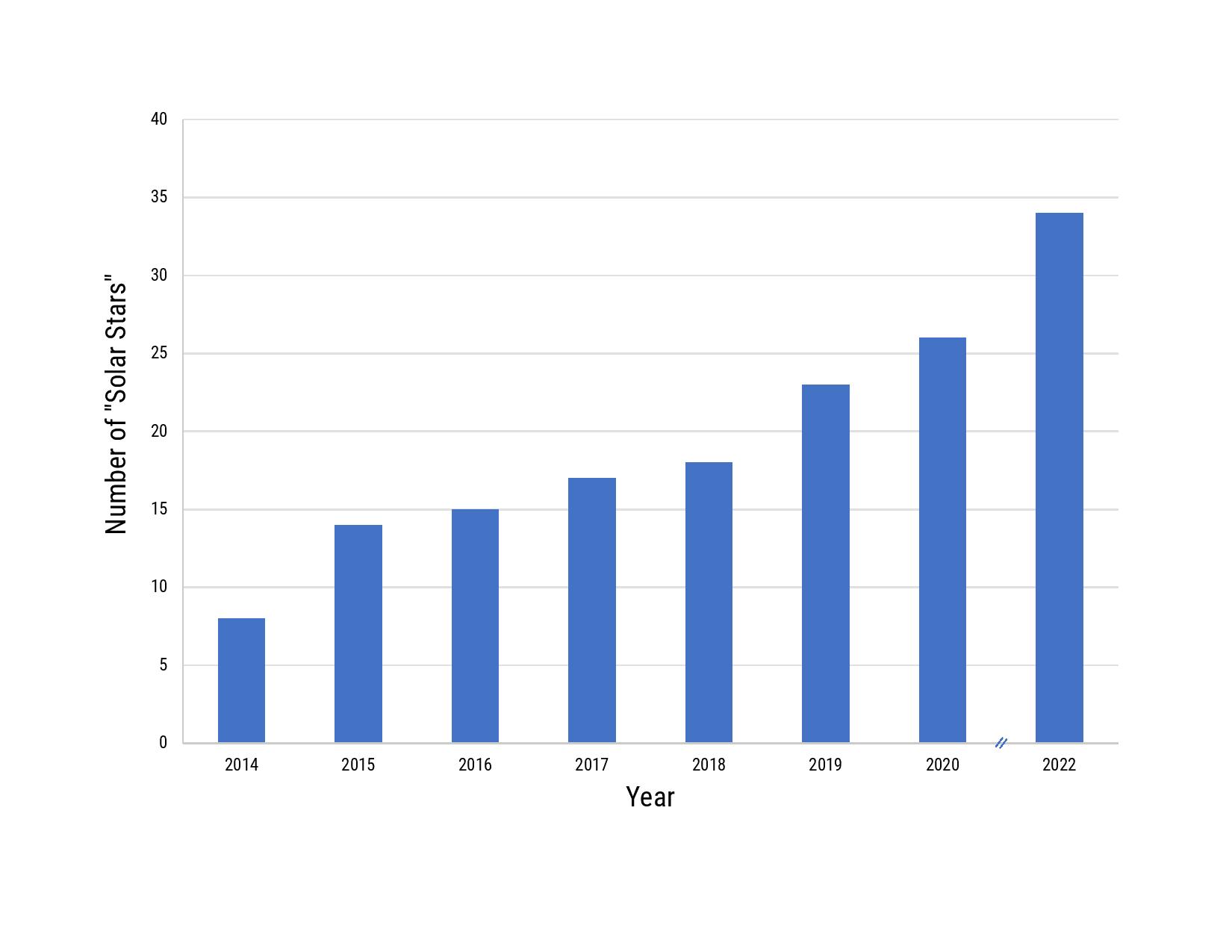
The cities with the most solar PV installed per resident are the “Solar Superstars” – cities with 100 or more watts of solar PV capacity installed per capita. Next are “Solar Stars” with over 50 watts per person. In 2014, only eight of the cities surveyed for this report had enough solar PV per capita to be ranked as “Solar Stars,” but now 34 cities have earned the title.
Honolulu leads the United States for solar power per person among cities surveyed, followed by Las Vegas, San Diego, Albuquerque and San Jose.All of the “Solar Superstars” have experienced strong and sustained growth in solar energy and are setting the pace nationally for solar energy development.
Table ES-1. The “Solar Superstars” (cities with 100 or more watts of solar PV per person, end of 2021)
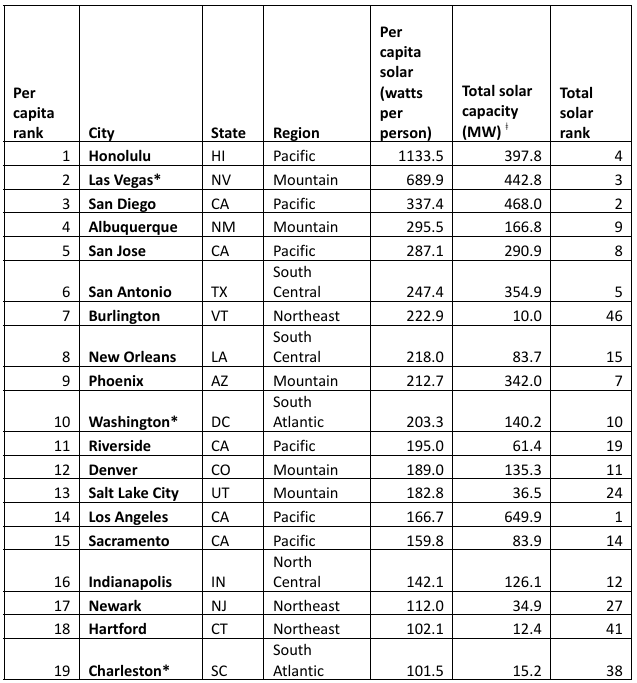
ǂ Throughout the report, includes all solar PV capacity (rooftop and utility-scale solar installations) within the city limits of each city in DC Megawatts. Does not include solar power installed in the extraterritorial jurisdictions of cities, even those installed by or under contract to municipal utilities.
*Due to an improvement in methodology or data source for this city, total and per capita solar PV capacity reported in this table may not be directly comparable with estimates for this city in previous editions of this report.
Los Angeles leads the nation in total installed solar PV capacity among all cities surveyed in this report, as it did from 2014 to 2016 and from 2018 to 2020, after briefly being topped by San Diego in 2017.
Table ES-2. Top 20 shining cities by total installed solar PV capacity, end of 2021
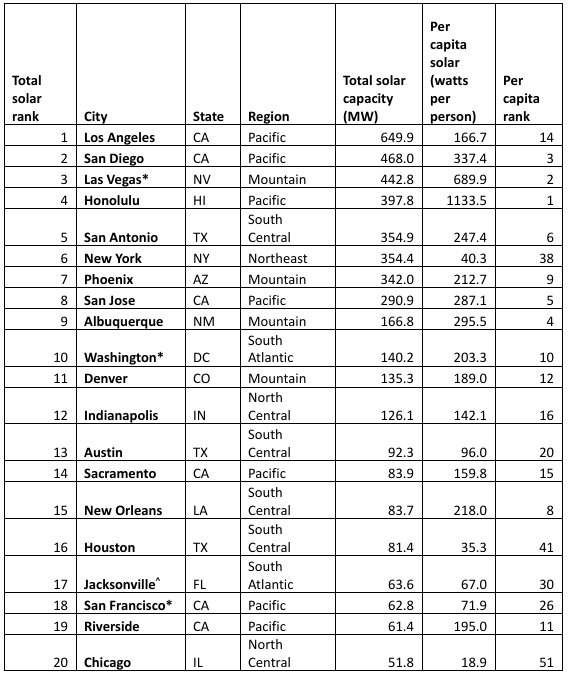
* Due to a change in methodology or data source for this city, total and per capita solar PV capacity reported in this table may not be directly comparable with estimates for this city in previous editions of this report. See Appendix B for details on specific cities.
^ Updated data not available. Capacity estimate is from Shining Cities 2020.
Leading solar cities can be found in every region of the country. Leaders in per capita solar capacity by census region include Honolulu in the Pacific region, Las Vegas in the Mountain region, Indianapolis in the North Central region, San Antonio in the South Central region, Washington, D.C., in the South Atlantic region, and Burlington in the Northeast region.
Fossil fuel interests and some utilities are working to slow the growth of distributed solar energy. Over the past few years, many states have considered or passed rollbacks to net metering – the critical practice of crediting solar energy customers for the excess energy they supply to the grid. Additionally, some states and utilities continue to target solar customers with special fees, charges and rate designs in order to reduce the appeal and financial promise of installing solar panels. These changes undermine the value of solar power, and can stall cities’ development of their solar resources.
To take advantage of the nation’s vast solar energy potential and move America toward 100% renewable energy, city, state and federal governments should adopt a series of strong pro-solar policies.
Local governments should, among other things:
State governments should, among other things:
Adopt and preserve strong interconnection and net metering policies that support, not punish, solar adoption.
Set a target of using 100% renewable energy, put a plan in place to reach that goal, and encourage utilities to pursue a 100% renewable energy supply.
Encourage solar energy installations through incentives such as rebate programs, green bonds, Commercial Property Assessed Clean Energy (C-PACE) financing, tax credits and financing programs such as low- or zero-interest loans.
The federal government should, among other things:
Continue and expand financing support for solar energy, particularly the Solar Investment Tax Credit, which currently provides a 26% tax credit for the cost of installing solar panels. The credit should be restored to 30% and extended to apply to energy storage systems, such as stand-alone batteries.
Continue to support research to drive solar power innovations, such as the U.S. Department of Energy’s Solar Energy Technologies Office.